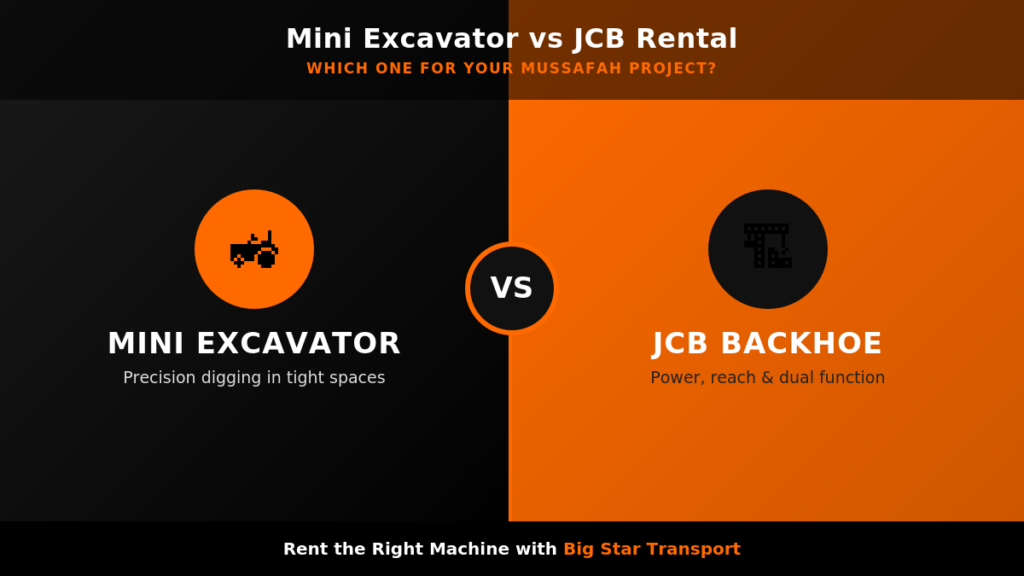
Standing on a construction site in Mussafah, wondering whether to rent a mini excavator vs. a JCB backhoe loader for your project? A mini excavator or a JCB backhoe loader? Beyond looks, both machines dig dirt well. They can even do identical jobs — that’s why you’ll spot both on nearly every construction site in Mussafah. Renting the wrong machine, however, costs you much more than a financial penalty. This can hold back your whole project.
It’s never about which machine is “better”—a mini excavator or a JCB. It’s about which one actually works for the task at hand. Knowing the nuts-and-bolts differences between a mini excavator vs. a JCB rental will prevent you from paying for capability you won’t use—or, much worse, arriving with a machine that can’t cope with site conditions.
What Is a Mini Excavator?
Mini excavator: It’s a small, tracked machine with an exact tread. It has a 360-degree rotating cab, which allows the operator to dig, swing, and dump material without having to reposition the entire machine. Pairing a low tail swing with this design lets mini excavators work in tight, confined areas. (The back overhang behind the cab), mini-excavators can comfortably work in tight, confined areas too small for larger machines to enter.
And because of this, Contractors prefer mini excavators for the following
Utility trenching in narrow areas
Landscaping and site grading
Excavation for the foundation on residential or small commercial projects
Any job that requires finesse and fine-tuning over brute strength
Due to their tracked base, mini excavators also perform well on uneven or soft terrain, as they have a solid grip in unlevelled sites.
What Is a JCB Backhoe Loader?
A JCB backhoe loader combines two machines in one—that’s its major benefit. This design brings together a front loader bucket with a rear digging arm; therefore, one machine can dig a trench and immediately load the muck without tooling up between the two.
A JCB backhoe loader revolves about 200 degrees, not a full 360 like a mini excavator. For all that it loses in rotation, however, it more than makes up for it in power and flexibility. JCB backhoe loaders are also road-legal, so they can drive between nearby projects instead of riding on a flatbed after each job.
JCB BACKHOE LOADERS: SITUATIONS WHERE THEY ARE IDEAL
Foundation excavation on larger sites
Combined Site Clearing and Material Handling
Trenching—where depth and power are more important than tight maneuverability
1) An approach where multiple locations are nearby, so the machine needs to move between them
Key Differences at a Glance
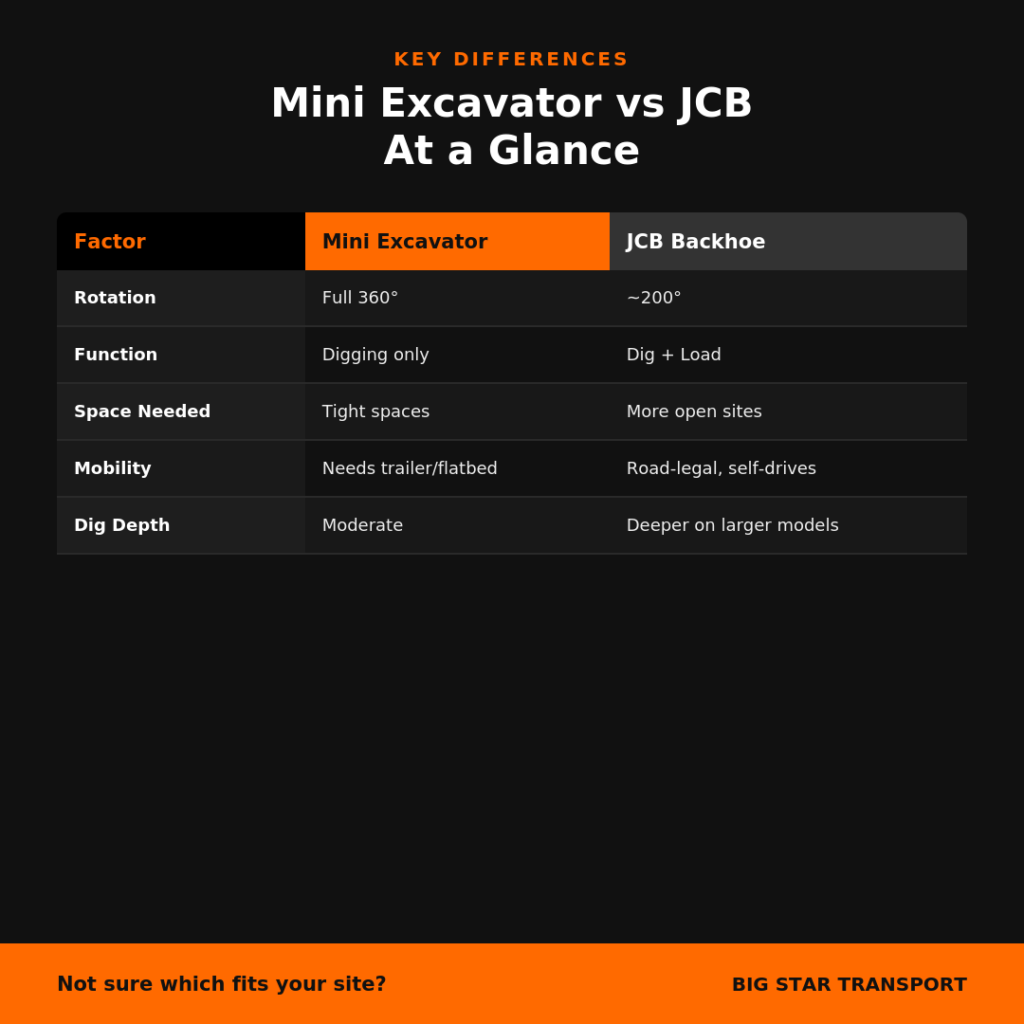
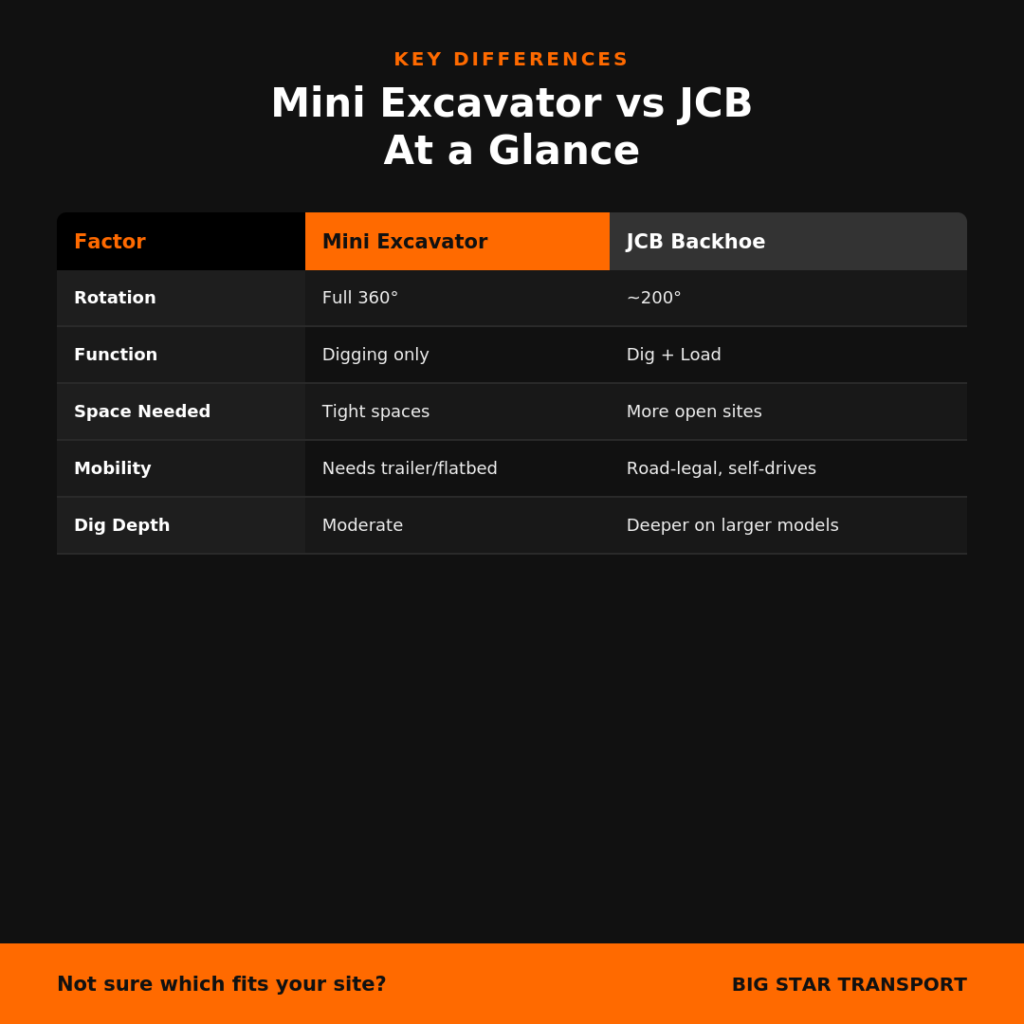
When comparing mini excavators vs. JCB machines, the biggest deciding factor is your jobsite space and the type of work required. Here’s how the two machines compare, feature for feature, on factors that will actually affect your project:
Rotation and maneuverability—Unlike larger machines, mini-excavators are capable of a full 360-degree rotation, providing an advantage in tight or oddly shaped job sites. These machines can swing around 200 degrees, which for open sites is satisfactory but much more restrictive in tight environments.
Function—A mini excavator handles one primary function: digging. JCB coined the term “backhoe loader” from one standalone machine that combines both digging and loading, eliminating a second machine for getting on-site.
Available space—When space restricts the working area, mini-excavators work wonders. A JCB backhoe loader will require more space to turn—due in large part to the lower rotation range.
Mobility between sites—Often JCB backhoe loaders can self-drive along roads between nearby locations. Contractors often move mini machines using a trailer or flatbed.
Dig depth & power: Bigger JCB backhoe models can dig much deeper than many mini excavators, making them the better option for deep foundations or larger trenching.
Mini excavators adapt well to smaller, tighter projects. This leaves JCB backhoe loaders more suited to larger jobs that require a dig-and-carry approach.
Mini Excavator vs JCB: Which One Should You Rent?
What makes the right choice really depends on your site conditions and type of work.
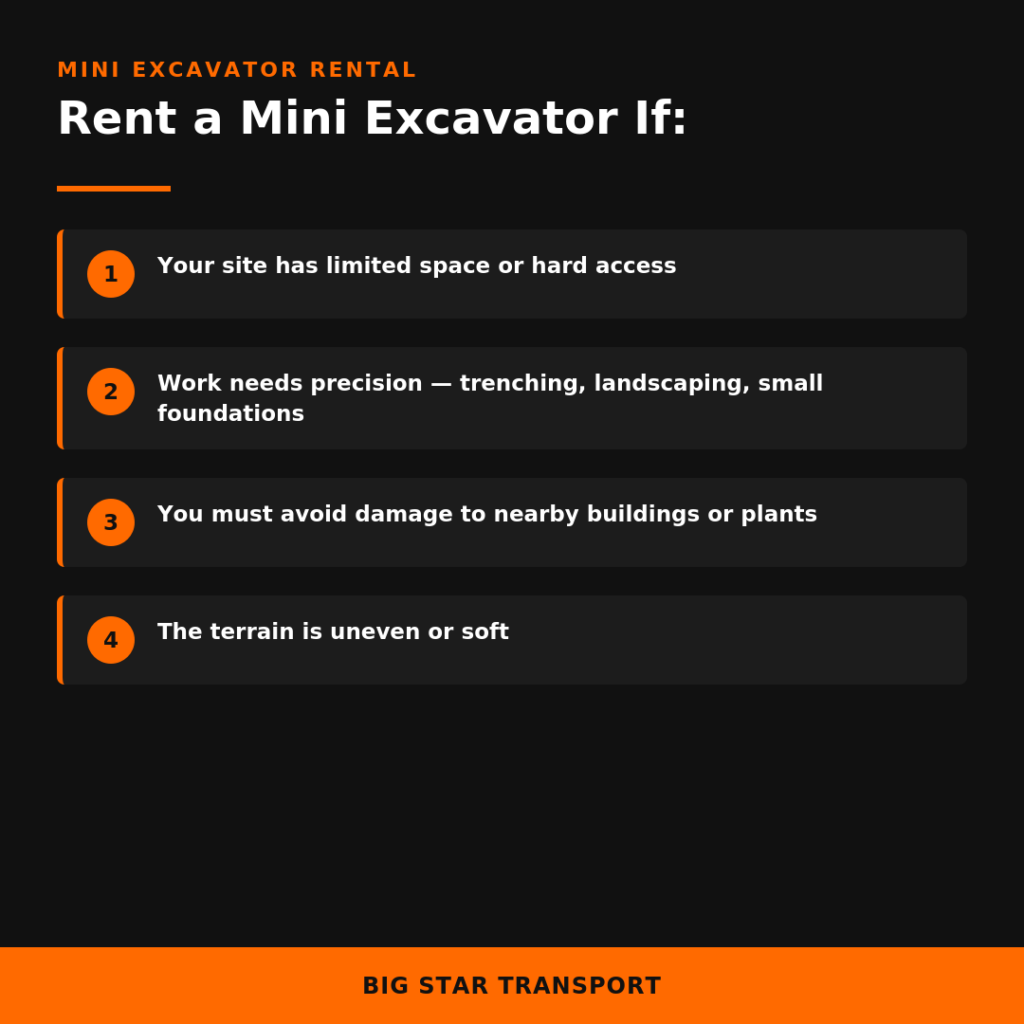
Rent a mini excavator if:
There is limited space at your site or simply hard access available
The work is precision-focused: landscaping, utility trenching, or small foundation jobs.
You must avoid damaging buildings and plants around the area
The terrain is uneven or soft
Rent a JCB backhoe loader if:
The excavator attachment allows you to have both the digger and loader functionality in a single machine.
The project can include more extensive grading or excavating
The site is comparatively less restrictive in terms of space.
During the project, the machine will be required to travel between several proximate sites
Contractors often use both machines together on larger infrastructure-scale projects, like those in Abu Dhabi’s construction pipeline. A JCB backhoe loader handles initial site clearing and bulk material work. A mini excavator then comes in for precision trenching near existing structures
Conclusion
When it comes to mini excavators vs. JCBs, there isn’t one answer that fits everyone—your site, your space, and your needs will determine the right machine for you. Mini excavators excel in precision or tight space moves, whereas JCB backhoe loaders outperform them when raw power is needed for dual-function machines on larger, more open sites.
Getting the right machine for your project on day one saves you rental costs, prevents delays in the field, and helps to keep your site up and running efficiently.
Looking to rent a mini excavator vs JCB equipment in Mussafah? Contact Big Star Transport today, and our team will help you choose the right machine for your project.